


Canada, 2025
Homesession – Centre Clark – Écart
Exhibitions
2025 Écart, solo show, Canada
Photobook Roca Daurada, self-published, Rouyn-Noranda, 2025
The birth of image production was marked by limited access, dominated by an elite. Its documentary use imposed “truthful” narratives and justified the dispossession of Indigenous peoples. During colonization, small 20-centimeter photographic plates fragmented landscapes to forge an imaginary geography testifying to colonial advances.
From 1842, the Geological Survey of Canada (GSC) encouraged the exploitation of natural resources, making mining settlements a symbol of prosperity. This attracted prospectors like Edmund Horne, whose Horne Foundry contributed to the birth of Rouyn-Noranda. While the industry was celebrated for its economic benefits, it left behind a significant environmental legacy.
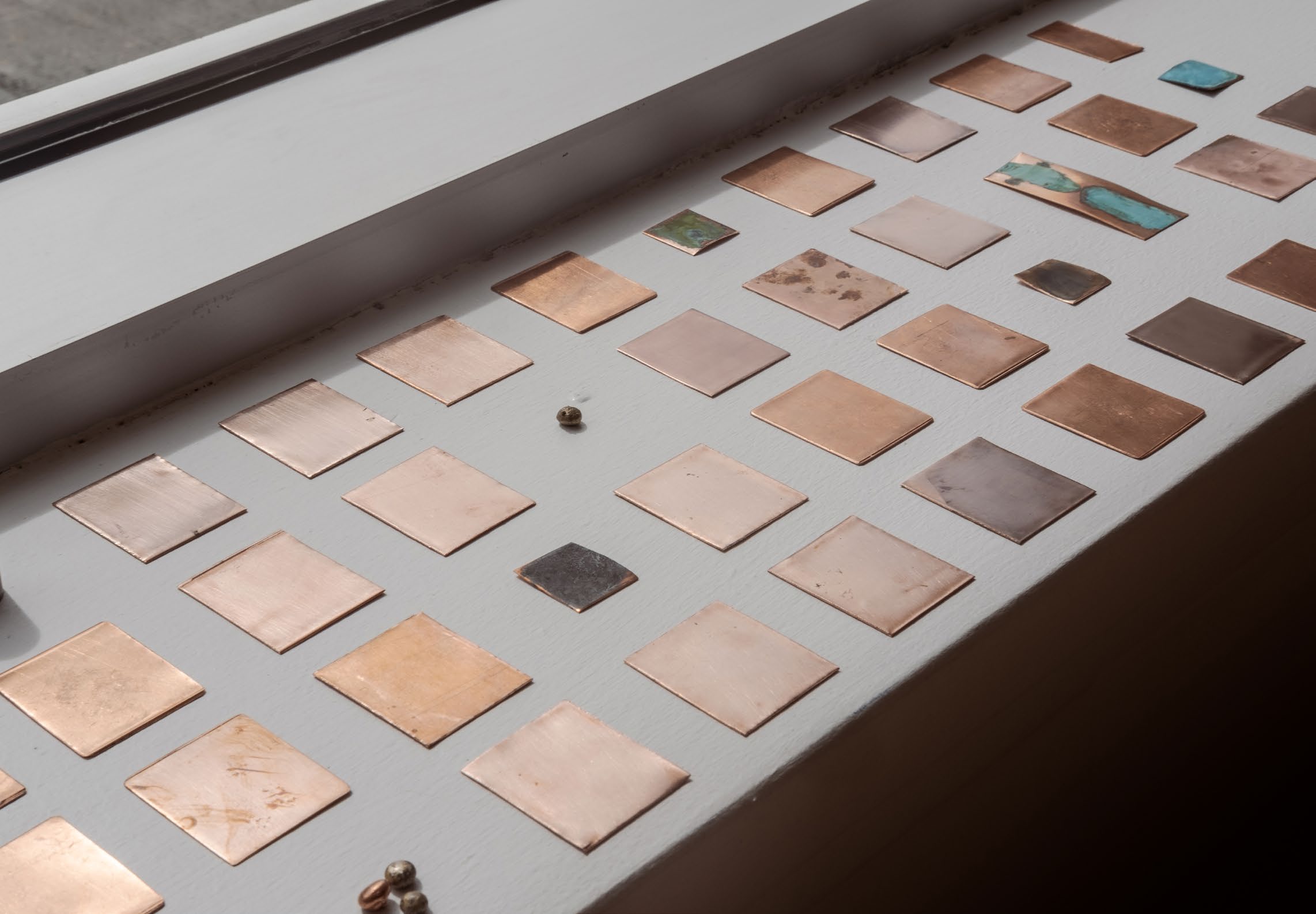
Water, copper, and silver nitrate—elements that define this region—are also the key components of the daguerreotype. This unique, small-format object captures a subject that becomes visible after a few minutes of exposure. Highly sensitive to light, the image remains etched as a fine dust on the plate, then protected by glass and a wooden frame.
The landscape, veiled in copper dust, reveals itself like a daguerreotype plate—both an image and a photographic medium in itself. My project explores this visual aesthetic through the concept of the ‘living daguerreotype’.
Research conducted in collaboration with Dr Daniel Proulx, Director of the National Observatory on Health and Environmental Impacts of Contaminants (NOHEIC); Dr Iuliana Calugaru, Project Manager at the Centre for Industrial Waste Technology (CTRI); Sébastien Tessier, Director of the National Archive in Rouyn-Noranda; Guillaume Proulx, PhD in Indigenous Studies, UQAT; Simon Taurines, Professor of Mineral Engineering, IRME–UQAT; Élisse Massy, Mille Feuilles Printmaking Studio; and Philip Hope, Coordinator of Industrial Processes, UQAT.